World History Class 04
A BRIEF OVERVIEW OF THE PREVIOUS CLASS AND Q&A SESSION (05:07 PM)
AMERICAN REVOLUTION (05:16 PM)
- The causes of revolution continued
- 2) Pattern of Trade- It was the other important factor
- In the trade with 13 colonies England applied principles of Mercantilism- Balance of Trade, Monopolistic trade, and the idea that colonies exist for the sake of the mother country.
- Under the pattern of trade England made colonies virtually dependent upon England. On one hand, England exploited the Resources of the colonies and at the same time on the other hand, England made the colonies a market for her manufactured goods.
- In 1750, Iron Act was passed which prohibited Iron smelting in the colonies.
- Under Navigational Acts, colonies were made to use only England-based ships (English Ships) in the import-export trade, and for that User charges were collected.
- Under the principle of monopolistic trade, colonies were not permitted to trade directly with Europe. Both the import and export trade between colonies and Europe was routed through England adding more to the burden of Tariff charges.
- In 1763, Molasses Act was passed. Under the Act colonies importing from French West Indies were taxed six penns for every gallon of molasses imported. This hit the wine-processing Industry of the colony, New England. Moreover, even though Cuba, the sugar bowl of the world offered more qualitative sugar for much cheaper prices, colonies were not permitted to import Sugar from Cuba. This pattern of heavily exploitative and unilateral trade practices in England irritated the colonies
- Colonies only wanted a change in the pattern of trade and the attitude of England. They were definitely not for Independence.
- Other factors for the revolution were
- a) Temperament-wise, Most of the English settlers in America were protestants. They were known for their spirit to revolt, their spirit to question absolute authority.
- b) Long distances of 4000 miles between England and the 13 colonies made colonies naturally feel that they were different.
- c) After the 7 years of war (1756-63) defeated France was made to surrender all its colonies except Lousiana. The threat of the French ended and it made the colonies turn more confident and aggressive against England.
- d) After 7 years England's parliament prohibited the migration of Americans towards the Appalachian Mountains (Westward Migration). The Act naturally caused resentment among the colonies.
- e) After the 7 years of war, to cover up the expenditure incurred in the war England continued to tax the colony and added more burden to the colonies. 1763, Molasses Act was replaced by the 1764, Sugar Act.
- Prime Minister of England, George Greenwell continued to add new items of trade under the list called "Enumerated Articles" adding more tax burden just as "Townshend duties" were also levied. For England, it was justified to tax the colonies as it protected them against France during 7 years of war.
- American nationalism took a concrete shape/ Organised shape for the first time with the 1765, Stamp Act. As per the Act, all legal transactions and registrations must go with the revenue stamps of England.
- A nationwide reaction started in the 13 colonies against the Stamp Act for the first time, out of the 13 colonies 9 assembled at New York. For the first time, they gave the slogan "No Taxation Without Representation". [ * It was actually part of the Magna Carta, 1215 of England. From there it entered America, From America, it entered France and India. It inspired all the nationalist movements against colonialism and Imperialism. 1892 Indian Council Act was the result of this slogan ]
- The Stamp Act movement was so intensive that Parliament revoked the Act, giving a moral victory to the colonies. Even after that, England continued to assert its right to legislate on colonies by introducing the Declaratory Act.
- In 1770, Peoples's movement turned violent in Boston. Three people died in the firing. The local press magnified the issue and projected it as the "Boston Massacre".
- In 1773, an incident called the "Boston Tea Party" took place. In Boston, the Adams brothers, Paul Adams, and Sam Adams dumped tea sachets in the sea causing a loss to the company trade. Boston port was closed, and the incident marked the beginning of the War of Independence.
- In 1773, the First continental conference was held in Philadelphia. It was at this conference "The Declaration of Rights of Man and Citizens" was drafted. A resolution was passed demanding parliament to withdraw/ revoke all the Acts passed after 1763. Parliament rejected the demands of the colonies and the war became unavoidable.
- In 1764, the second Philadelphia conference was held, and George Washington was made chief commander. Thomas Jefferson drafted the "Declaration of the War of Independence".
- War started at the places like Concord, and Lexington. Initially, the colonies' armies were defeated by the British Army commanded by Lord Cornwallis.
- France and Spain interfered in the war, their interference was timely. French navy commanded by Leffayat played an important role in defeating the British armies.
- The most important battle was the Battle of Yorktown, Here Cornwallis was defeated. War ended with the Paris Treaty, of 1783. In the treaty, England recognized the independence of 13 colonies.
EFFECTS OF THE AMERICAN WAR OF INDEPENDENCE (06:24 PM)
- Results of the American Revolution
- Revolution was more global than America in its content and consequences
- With the revolution, a democratic, liberal, and federal United States of America was formed. It was the first revolution in the history of mankind against colonialism. With the War of Independence, America emerged as a champion of democracy, liberalism, constitutionalism, and Federalism.
- America became the first country to go for a written constitution, thus constitutionalism started with the revolution.
- America became the first federal government.
- With the revolution, America proved to the world that people in spite of their cultural, communal, racial, and linguistic differences can come together for a common cause.
- Revolution affected England, France, and Latin American countries, thus it was more global/ universal in its effect.
- In England, changes happened were
- a) King George III and Prime Minister Lord North both held responsibility and resigned.
- b) The revolution divided public opinion in England.
- c) Great parliamentarians like Edmund Burke, and William Pitt, the younger sympathized with the colonies whereas PM Lord North and King George III opposed the idea of independence.
- Their ideology became the basis for the formation of the conservative party whereas the formation of the labour party was due to the ideology of Edmund Burke and William Pitt. Thus the two-party system in England was the result of the revolution.
- d) There was a clear change in the attitude of England after the revolution. The loss of America was a big blow to England. She followed a liberal policy after the revolution towards her other white colonies like Canada, Australia, and New Zealand. They were given autonomy to a greater extent.
- England also recognized the autonomy of the Irish Parliament.
- However, England's policy towards India became harsh, it tightened its control over India, to compensate for the loss of America Lord Cornwallis was sent to India to develop a British Empire in India.
- England followed a policy of ruthless exploitation of India's resources as she came to depend more and more upon India.
- The revolution was global in the sense that it affected Europe and Latin America also. Its impact was direct upon France. In other words, the French Revolution of 1789, was the result of the American Revolution.
- Impact on French Revolution
- French Army participated in the American Revolution and was inspired by ideas like Democracy, liberalism, and Human Rights.
- French commander Leffayat who led the French army in the American Revolution was the first to start the French Revolution by organizing the "Oath of Tennis Court"
- When the French Revolution started, the revolutionary drafted "The Declaration of the Rights of Man and Citizens" on the model of the American Revolution.
- By participating in American Revolution, France Incurred heavy expenditure, and a financial crisis started in France and she could never recover. It was the financial crisis that became the immediate cause of the French Revolution.
- With the American Revolution, America emerged as a "Big Brother" for the Latin American countries. It supported the freedom struggles of these countries against the Portuguese and Spain.
- Thus America could establish her domination over Latin America.
- After the revolution, America followed an aggressive foreign policy, under the "Munro Doctrine". America declared "Americas for Americans" threatening the European countries.
AMERICAN CIVIL WAR, 1861-65 (07:35 PM)
- It is considered the "Central Crisis" in American history. It enjoyed tremendous Political stability after its independence because of vast resources and developments.
- After the war of independence, two different systems, two different cultures, and two different production systems developed which made the clash unavoidable.
- Northern American states were industrially very well advanced (More no. of cotton mills were in Northern states). Rapid development occurred in Northern states.
- Federal government in America followed a protectionist policy in trade, commerce, and industry. Foreign companies were not allowed in America. Northern states enjoyed special protection.
- Federal system of financing- Every state was contributing. But this fund was used to invest in infrastructure. This benefitted Northern states.
- Education-wise - Northern states were also well-developed- Yale University, Boston University, and Pittsburg University.
- Southern States
- Completely dependent on agriculture, Feudal economy.
- They depended on extensive cotton cultivation and Tobacco. It required extensive soil. It also required a large number of labour. It incurred heavy expenditure.
- During cotton cultivation, the fertility of soil gets affected easily, and it requires a new stretch of soil.
- Getting independence did not benefit the Southern states as earlier they used to export via England and now they had to export first to the northern states' ports and then to the international market. This increased the tax burden on the Southern states.
- Southern states- Feudalistic; whereas Northern states- Capitalistic societies.
- The differences between the Culture, Different production systems, and society increased the Friction between the northern states and Southern states and SLAVERY became the excuse around which civil war was fought.
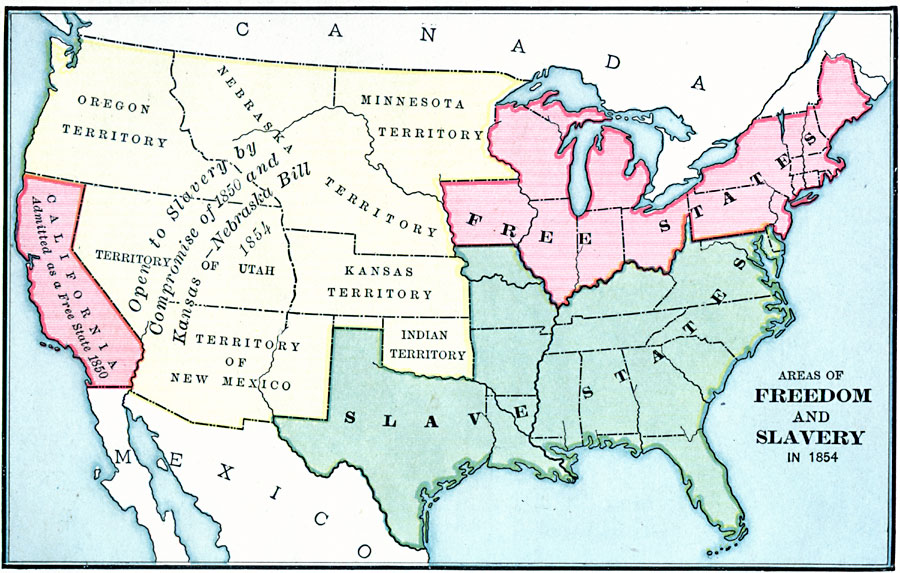
- Southern states imported slaves from Africa. The slave trade was unavoidable for the southern states.
- Whatever was the "Necessary Evil" for the southern states became the "Nations Shame" for the northern states. Northern states took the moral high ground.
- Northern states started systematic propaganda and branding the southern states as Sinners, unchristian, Criminals, etc. Northern states gave a call for a Boycott of Northern states.
- In 1809, An Act was passed banning the slave trade.
- Political implications-
- America was expanding and new states were emerging. The question was whether the new states should join "With Slavery" or "Without Slavery".
- A new state joining with slavery will be advantageous to the Southern states and vice versa. This was going to change the political equations at the centre.
- Mississippi was the first state to join the federal government. And it joined as a state with Slavery.
- California joined without slavery and Texas joined the federal government with slavery.
- It was at this juncture, H P Stowe wrote "Uncle Tom's Cabin" to highlight the plight of slaves.
- 1854- Kansas- Nebraska Act came.
- Around this time a SC judgment came which favoured the southern states.
- Also, Presidential elections were notified.
The topic for the next class:- American civil war dictation.